- Case Study
- Enterprise
- AI Product Design
- Regulated Workflows
- Product Design
Human-in-the-loop AI for clinical trial documents
An agentic AI MVP that receives, checks, and files trial documents, with reviewers in control of every decision.
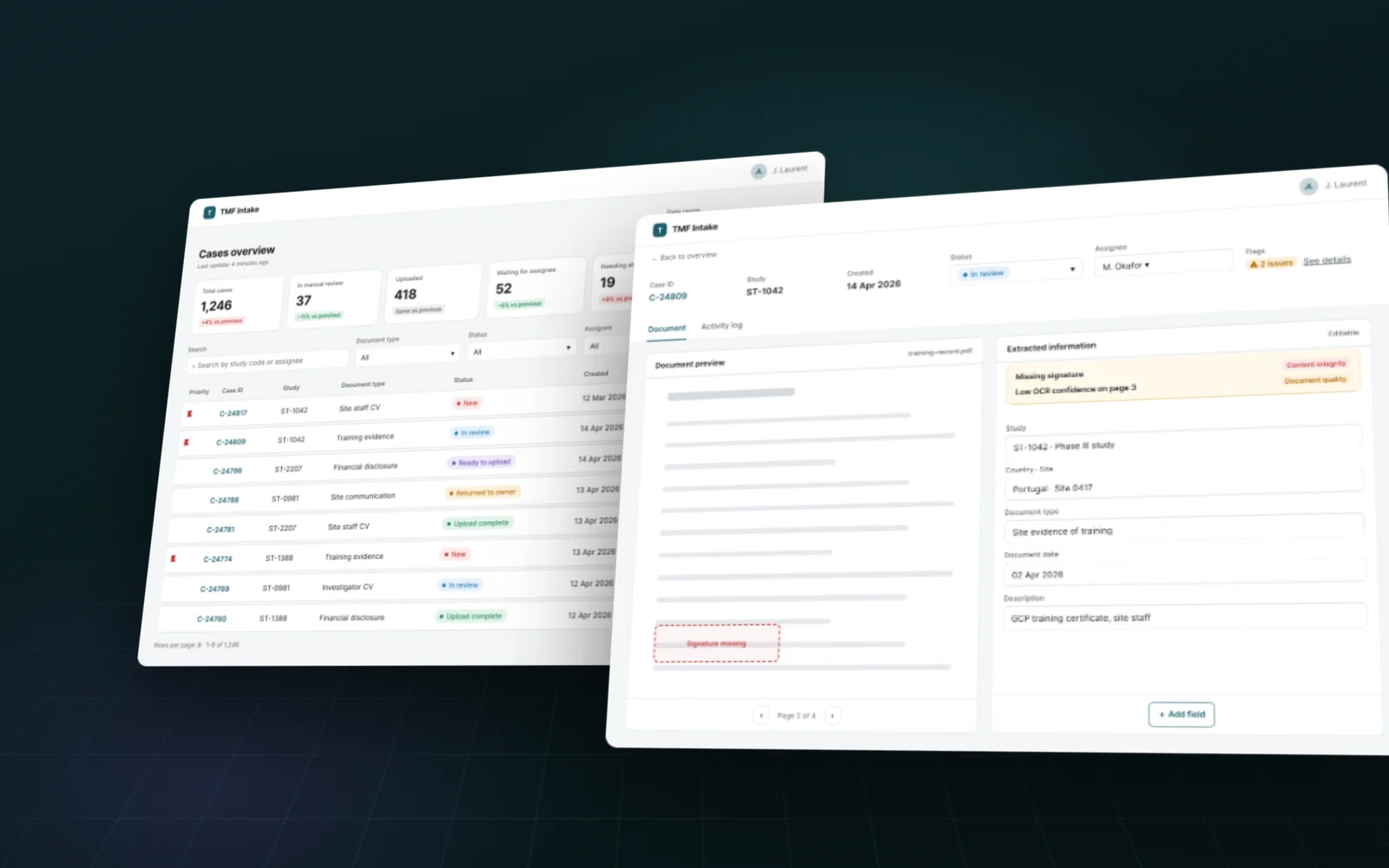
- Company
- Global biopharmaceutical company (Top 10, under NDA)
- Product
- Internal tool for trial document intake and quality control
- Market
- Clinical operations · R&D
- Role
- Sole product designer, from discovery to MVP design
TL;DR
Study teams in a global biopharmaceutical company file thousands of trial documents every month by hand: upload, classify, fill metadata, check quality, chase missing signatures. I was the only designer on a cross-functional programme that reimagined this process with AI agents, from discovery to the detailed MVP design. The result is a review workspace where AI does the repetitive work and people make every decision, now moving into build.
Context
Every clinical trial keeps a Trial Master File (TMF): the official record of all the documents that prove the study was run correctly. Regulators inspect it, so every document has to be in the right place, with the right metadata, complete, and signed.
Keeping it up to date is heavy manual work spread across local study teams and central operations. The programme’s goal was to find where AI could take on that work safely, and to prove it with an MVP before scaling across R&D.
The problem
A compliance-critical process held together by manual effort
Mapping the current process with study teams and operations showed where the effort and the risk sat:
- Manual entry everywhere: every document classified and described by hand, field by field.
- Late quality checks: problems such as a missing signature or an unreadable scan were found long after upload, in periodic checks run in spreadsheets.
- Back-and-forth with document owners: incomplete submissions came back to local teams with little context about what to fix.
- Scattered work: documents waiting to be filed moved across mailboxes and repositories, which made the work hard to track and audit.
Adding AI on top of this as it was would only move the risk. The workflow itself had to be redesigned around it.
My role
I was the only designer on the programme, working with operations, study teams, IT, architecture, and data science from the first workshop:
- Ran discovery interviews and mapped the current process end to end
- Designed the future-state flow with AI agents and human review
- Defined the information architecture, status model, and issue taxonomy
- Designed the reviewer workspace, from wireframes to high-fidelity UI
- Tested and iterated with reviewers and stakeholders, and documented the MVP for the build partner
Process & key contributions
01Discovery and current-state mapping
- Rationale
- Before deciding where AI fits, understand who does what today and where the effort concentrates.
- Action
- Interviewed study teams, central operations, IT, and data science
- Mapped the end-to-end process and marked the manual hotspots and hand-offs
- Outcome
- Agreement to focus the MVP on the highest-effort moment: document upload and quality control.
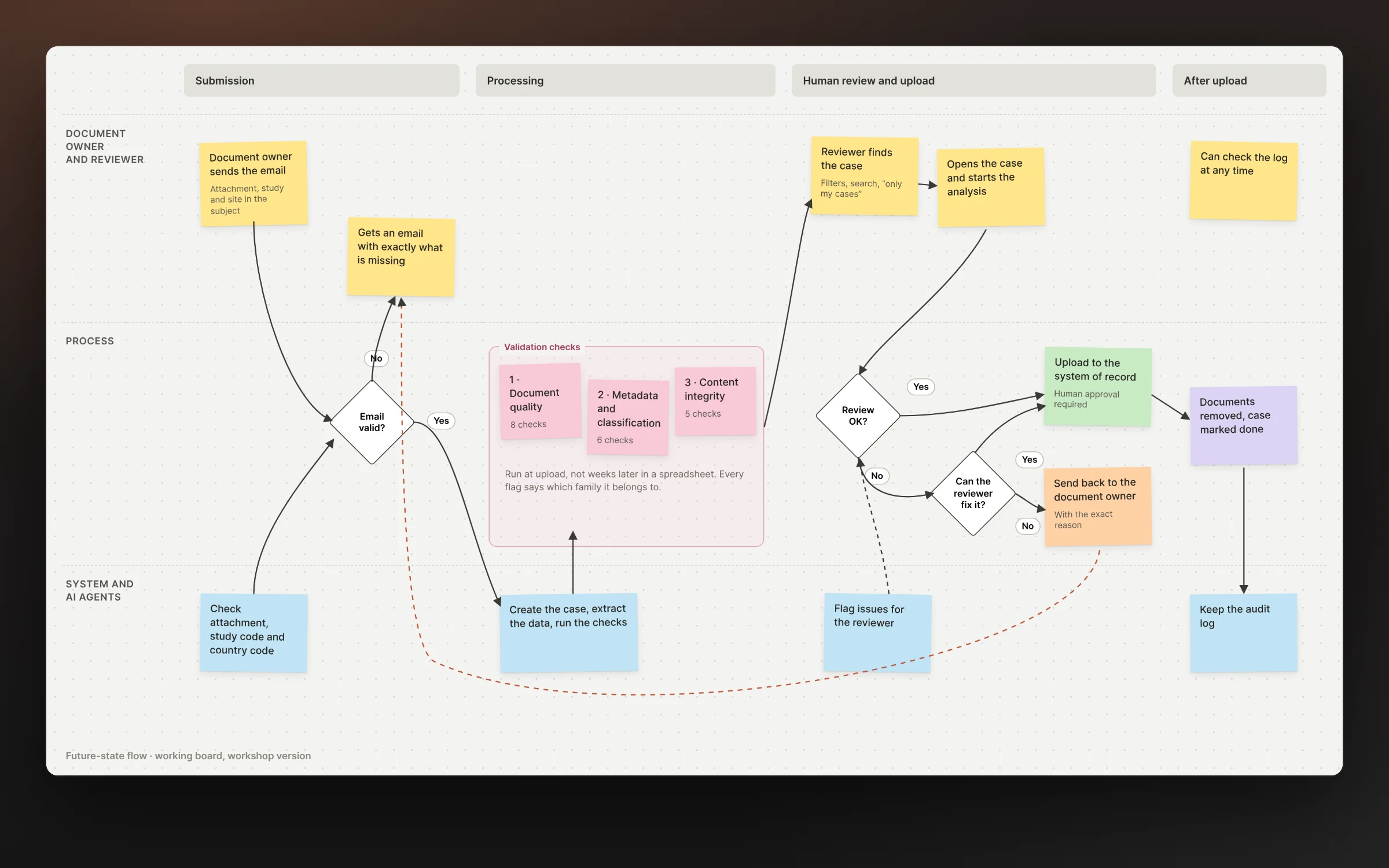
02A flow where AI assists and people decide
- Rationale
- In a regulated process, automation is only useful if accountability stays clear.
- Action
- Designed the future flow across three lanes: document owner, AI agents, and reviewer
- Put submission checks at the very start, so incomplete emails are bounced with the exact reason before a case is even created
- Made human approval mandatory before anything reaches the system of record
- Outcome
- A process the business, IT, and compliance could all sign off: AI removes repetitive work, reviewers keep every decision.
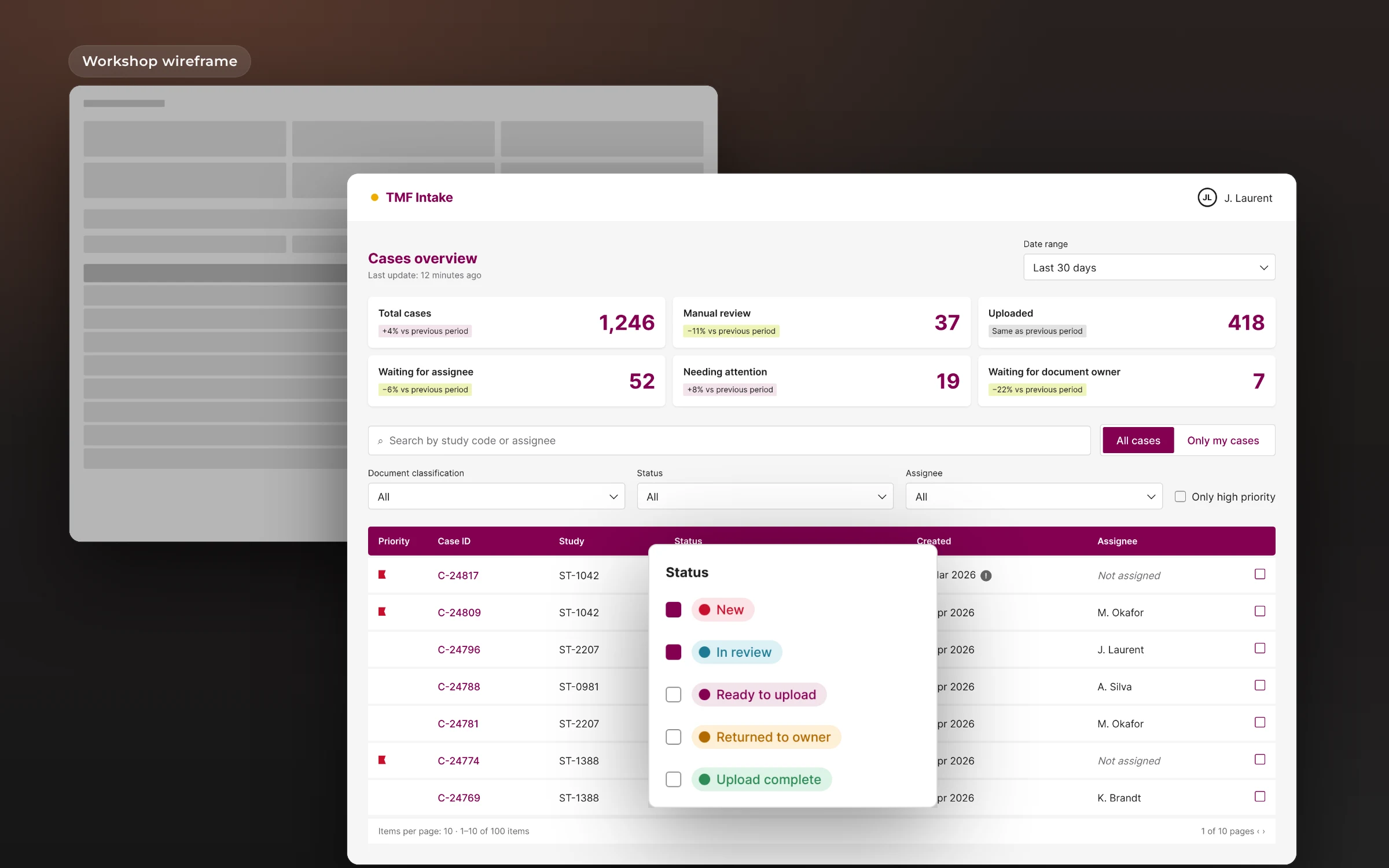
03One overview for the whole queue
- Rationale
- Reviewers need to see where attention is needed, not search for it.
- Action
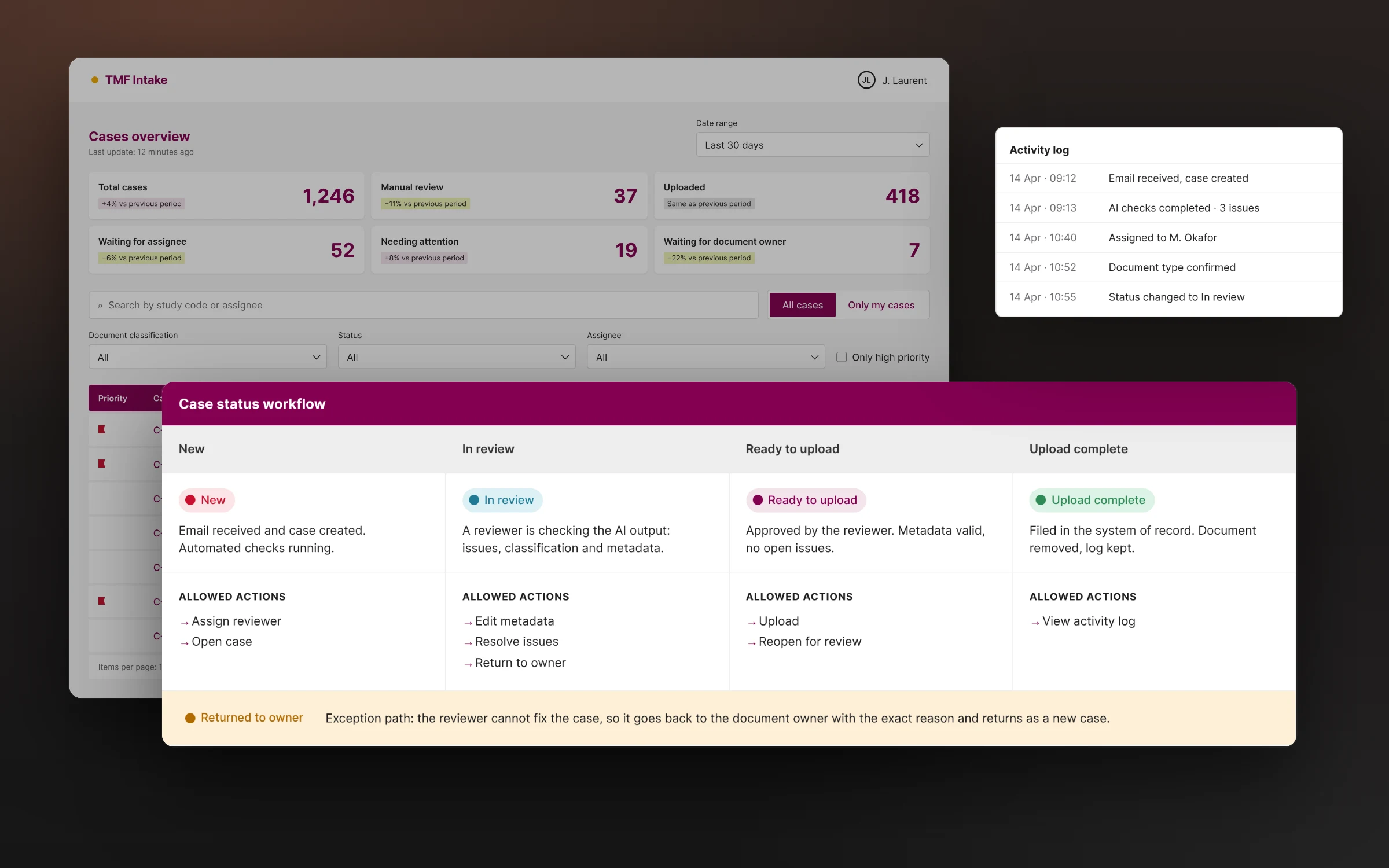
- Designed a cases overview with live indicators: in review, waiting for an assignee, needing attention, waiting for the document owner
- Added search, filters, date range, “only my cases” and “only high priority” views
- Flagged cases that stay open for more than 30 days
- Outcome
- The queue replaces mailboxes and spreadsheet trackers as the single place to manage the work.
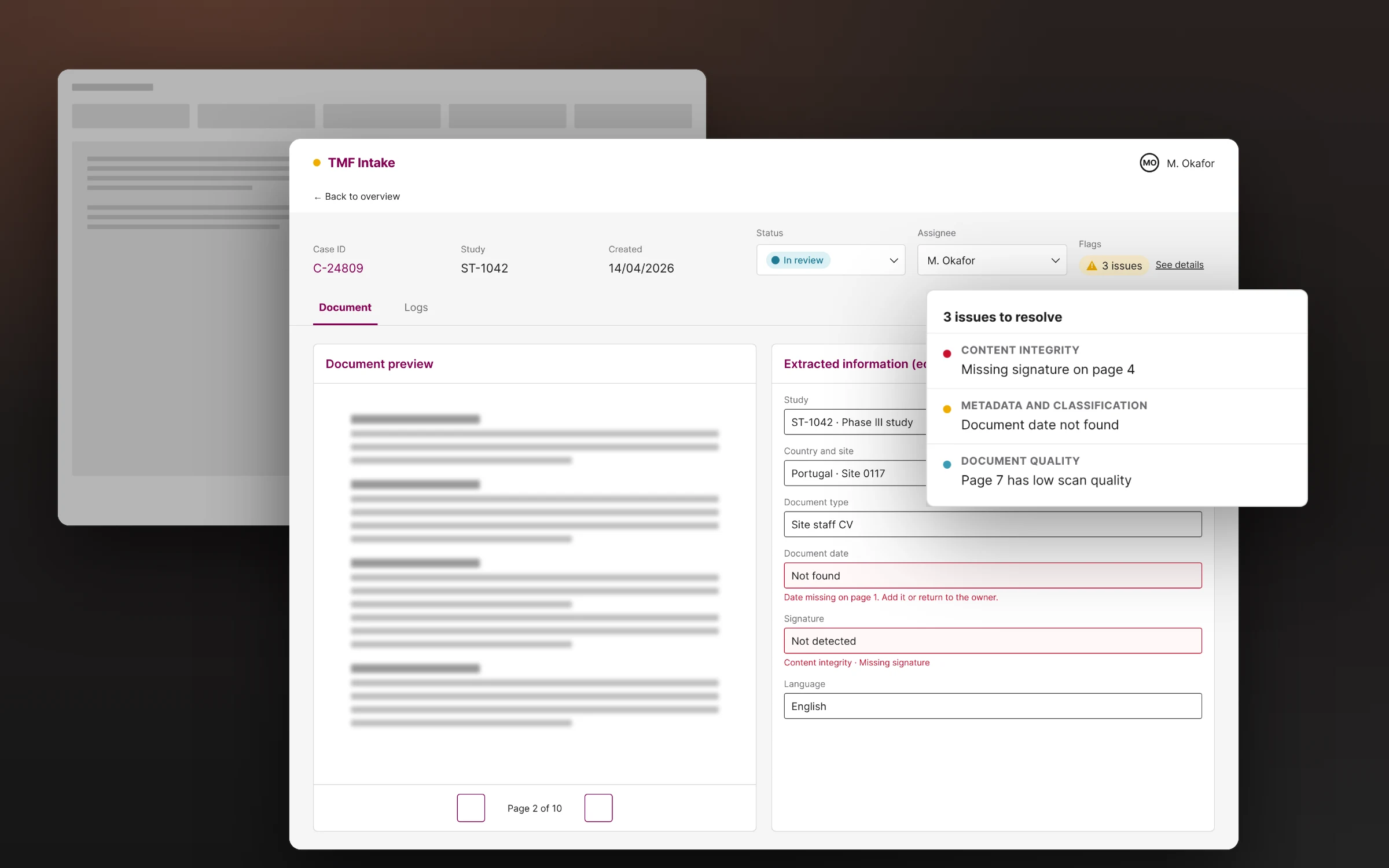
04A review workspace built around the document
- Rationale
- Checking AI output is only fast if the evidence and the result sit side by side.
- Action
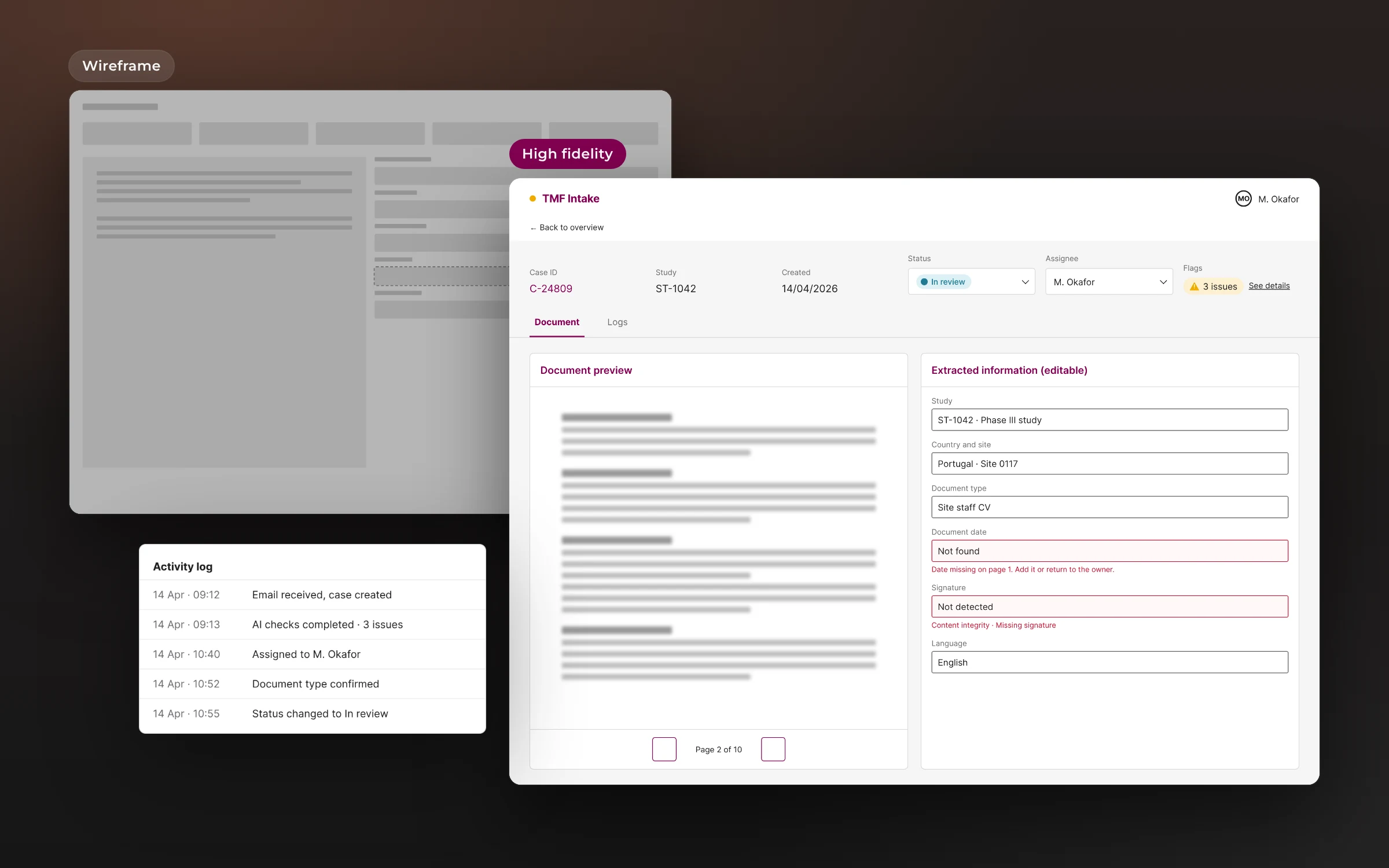
- Placed the document preview next to the information extracted by the AI, editable field by field
- Surfaced issues at the top, each labelled with its type
- Kept status, assignee, and the full activity log one click away
- Outcome
- Reviewers validate or correct a case without leaving the page, and every change is recorded.
05A status model everyone reads the same way
- Rationale
- Operations, IT, and the build partner needed one definition of each state, not three.
- Action
- Defined each status by what it means, what the system has done, and which actions are allowed
- Designed the return path to the document owner as an exception, with the reason attached
- Outcome
- The same model drives the interface, the requirements, and the notifications.
06An issue taxonomy for AI checks
- Rationale
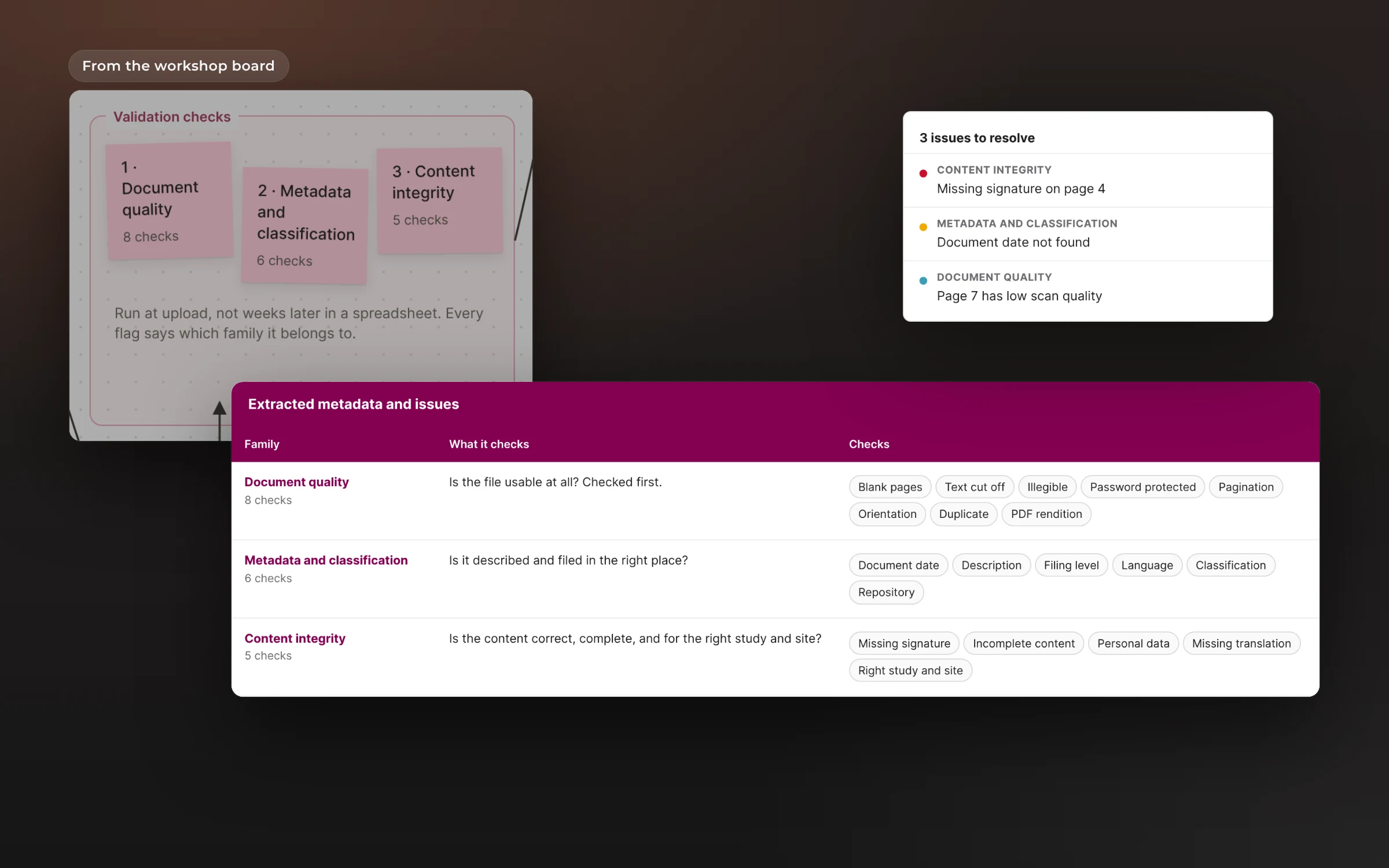
- A flag is only useful if the reviewer knows what kind of fix it needs.
- Action
- Grouped the 19 checks into three families: document quality, metadata and classification, and content integrity
- Wrote the submission and error emails so document owners know exactly what to correct
- Outcome
- Faster triage in review, and fewer incomplete resubmissions.
07Iterations and handoff
- Rationale
- An MVP design has to survive real reviewers and real IT constraints.
- Action
- Took the interface through two high-fidelity versions, refined with reviewers and stakeholders
- Covered edge cases: aged cases, empty and error states, emails, logout, and permissions
- Documented flows, states, and requirements for the build partner
- Outcome
- A design the build partner could estimate and start from without a discovery phase of its own.
Outcomes & impact
The MVP is in build, so there are no measured results yet. These figures describe the process as designed.
- 19
- quality checks at upload
- Run when the document arrives, not months later in periodic checks
- 100%
- of AI output validated
- A reviewer approves every case before it reaches the system of record
- 1
- queue for all documents
- Instead of mailboxes, spreadsheets, and several repositories
- Every
- action logged
- A full audit trail for inspections, even after the document is filed
What changes in the process:
- Less manual work: classification, metadata, and technical checks are prepared by AI; reviewers confirm or correct instead of typing.
- Problems caught at the source: invalid submissions are bounced immediately with the exact reason, and quality issues are flagged before filing.
- More reliable records: one status model, mandatory human approval, and a complete log make every filed document traceable.
- Ready to scale: the MVP is scoped to a small set of document types and one business unit, with a design built for R&D-wide use.
AI takes the repetitive work. People keep the decisions, and the record shows who decided what.
Why this matters
What this project shows:
- Designing AI products for regulated, audited environments
- Turning process mapping into a concrete product and service design
- Being the single design voice in a large cross-functional programme
- Designing human-in-the-loop experiences where trust and accountability matter
Final reflection
The hardest part was not the interface. It was agreeing where the AI stops and the person starts, in a way that operations, IT, compliance, and the build partner could all hold to.
Starting with the process instead of the screens made the MVP small enough to build quickly and clear enough to scale.