- Case Study
- Fintech
- Compliance UX
- Enterprise Onboarding
- Product Design
Uphold: KYB revamp
Business onboarding for a regulated crypto and finance platform, cut from 86 questions to 37.
- Company
- Uphold
- Product
- Enterprise Portal
- Market
- Enterprise clients · crypto and finance
- Role
- Senior Product Designer
TL;DR
Know Your Business (KYB) onboarding relied on a third-party tool and asked companies 86 questions across 8 sections, which caused friction, abandonment, and operational overhead. I led the redesign of the KYB flow as a native experience inside the Enterprise Portal, simplifying it while keeping it aligned with regulatory requirements. Conversion went from 35% to 73%.
Context
KYB is the compliance process that verifies the identity and structure of a business before it can access financial services. For enterprise clients onboarding to Uphold, it is one of the most critical moments in the journey: if it is unclear or too demanding, companies leave before they are verified.
The existing experience ran on a third-party platform that limited product control and created significant UX issues. Competitor analysis showed that platforms such as Kraken and Paxos ask far fewer questions while still meeting regulatory requirements. That gap was the opportunity.
The problem
A compliance flow that grew without design
The KYB experience was long, inconsistent, and hard to use, for enterprise clients and for the teams behind it:
- Excessive complexity: too many steps and questions, many of them confusing.
- Unclear roles: users could not tell their tasks apart or distinguish between corporate roles.
- No flexibility: no way to save progress, edit entries, or move around the flow.
- No ownership: the third-party tool created bottlenecks, slowed iterations, and limited control over the experience.
This hurt user confidence, completion rates, and operational efficiency.
My role
I led the UX redesign of the KYB onboarding experience:
- Diagnosed the existing onboarding journey
- Restructured the information architecture
- Defined role-based compliance flows
- Designed the native experience inside the Enterprise Portal
- Aligned Product, Compliance, and Engineering
Process & key contributions
01Discovery and diagnosis
- Rationale
- Before redesigning a compliance-driven flow, understand exactly what isn’t working.
- Action
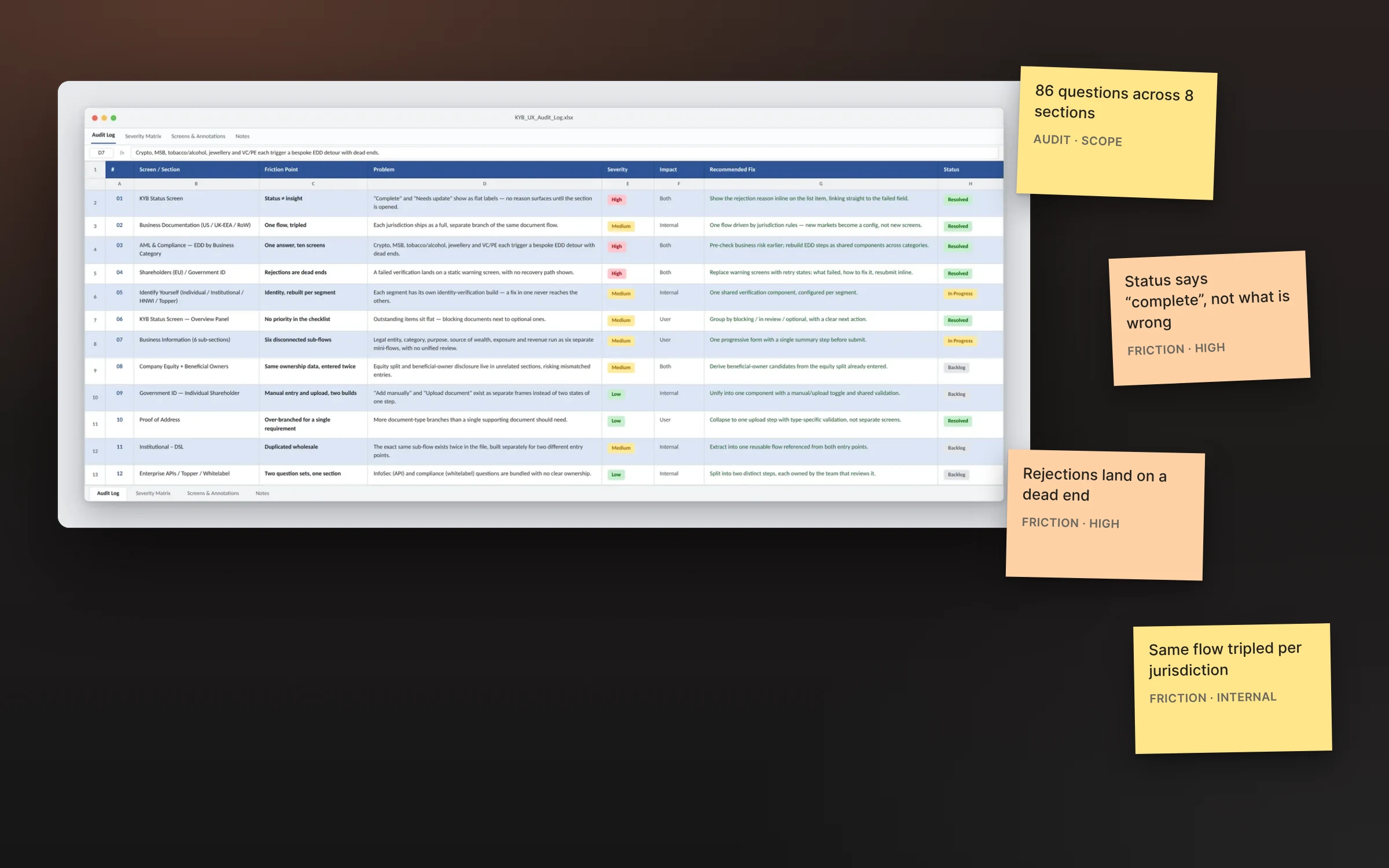
- Audited the existing KYB flow end to end
- Logged friction points, bottlenecks, and pain areas for users and internal teams
- Outcome
- Four problem areas that guided the whole redesign: complexity, unclear roles, lack of flexibility, and limited system control.
02User and stakeholder research
- Rationale
- In regulated products, user needs and business constraints carry equal weight.
- Action
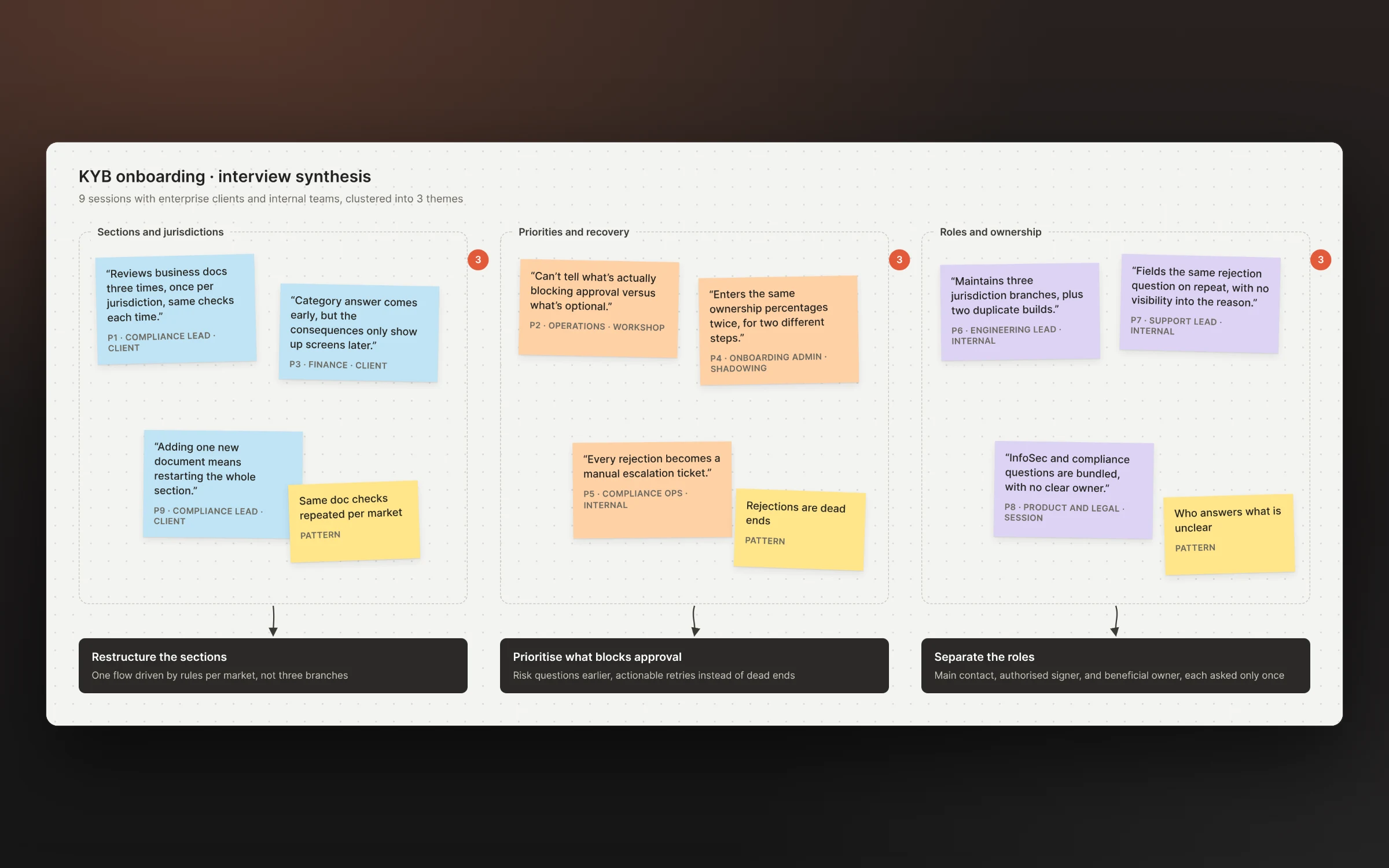
- Interviewed enterprise clients and internal stakeholders
- Captured workflow challenges, expectations, and operational requirements
- Outcome
- Insights that drove role separation, section restructuring, and feature priorities.
03Information architecture and flow
- Rationale
- Complex onboarding has to present information in a logical order to reduce errors.
- Action
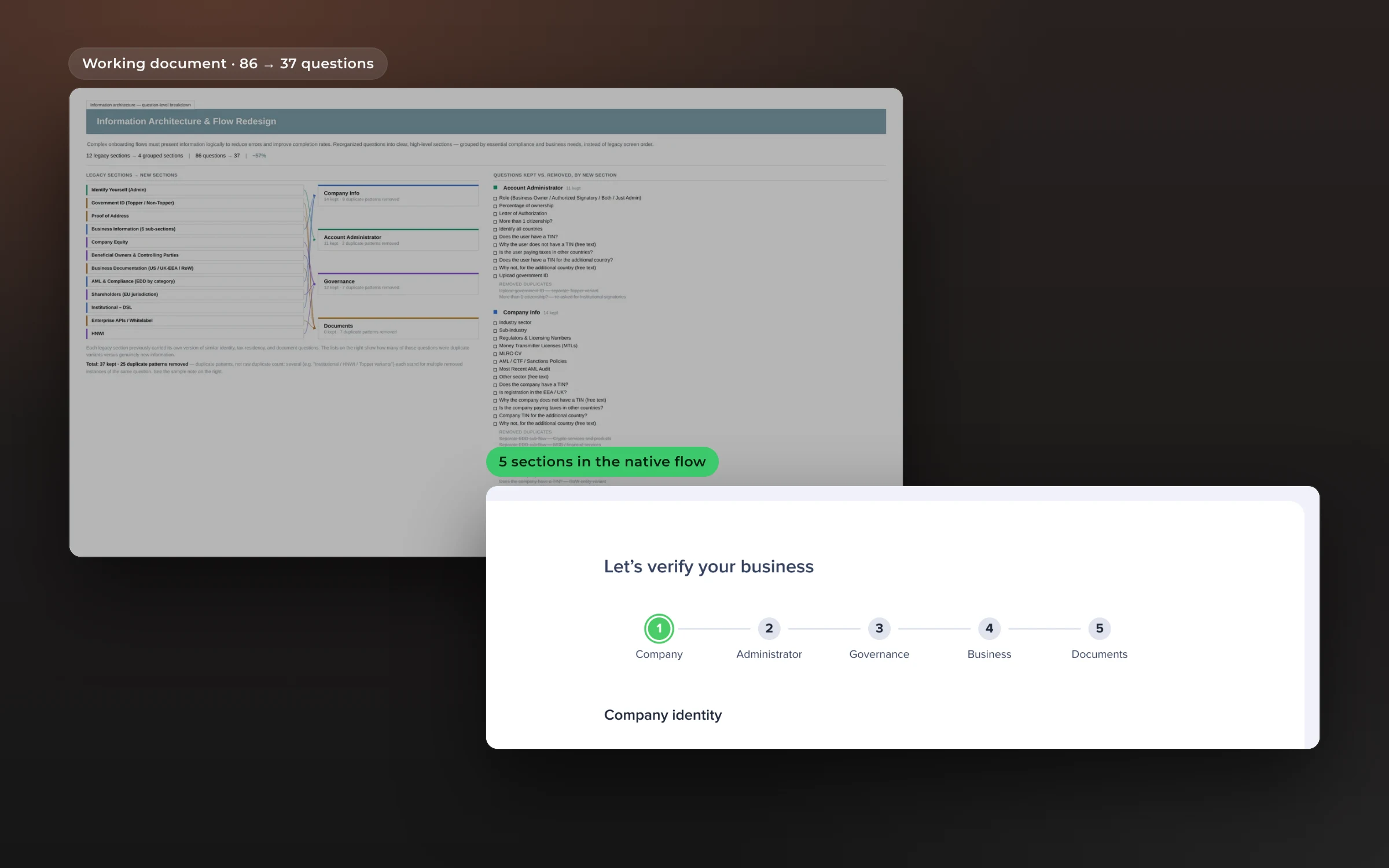
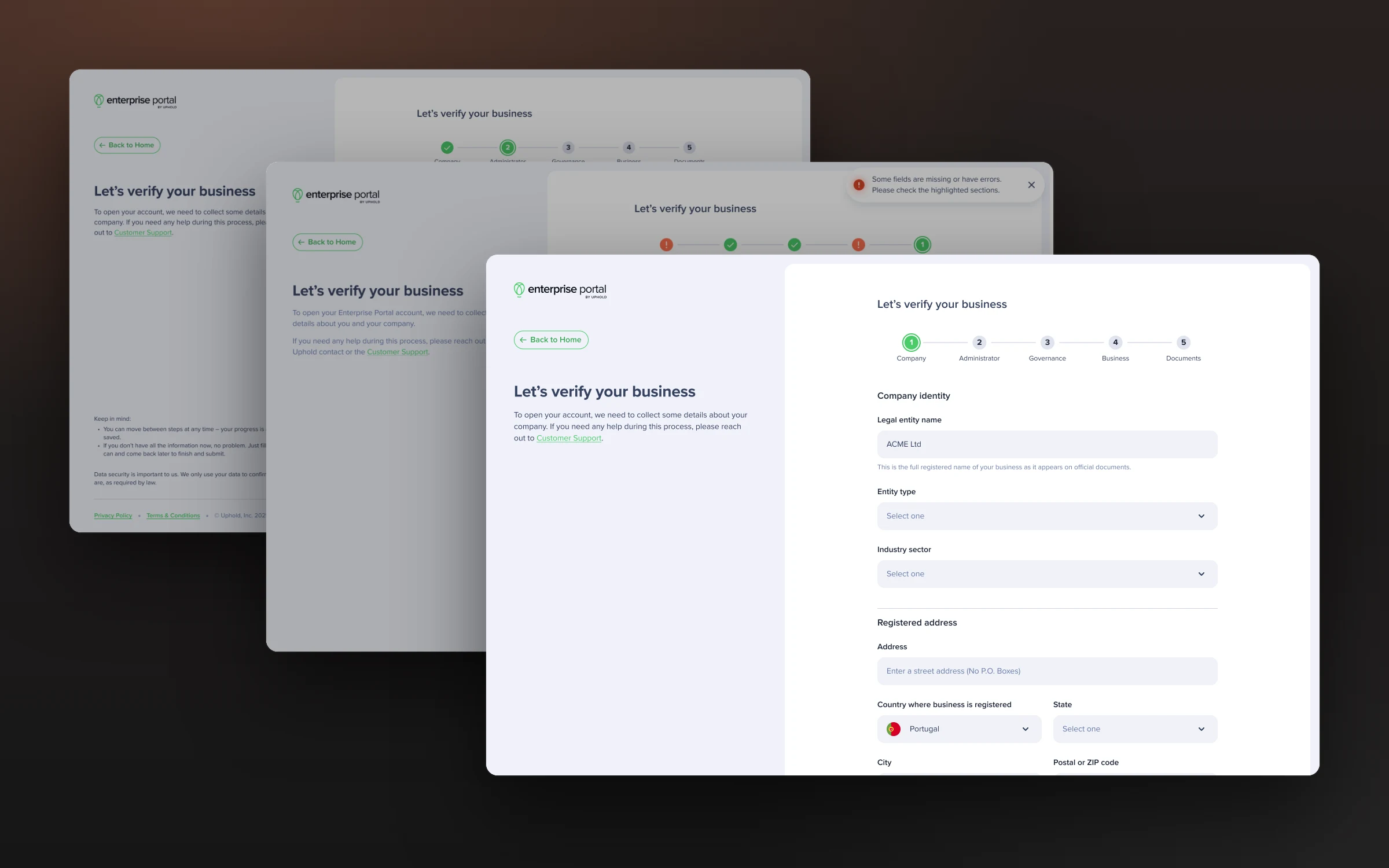
- Reorganized questions into clear, high-level sections
- Reduced the total from 86 questions to 37
- Grouped questions by essential compliance and business needs
- Outcome
- A simpler, structured flow with less cognitive load and clearer navigation.
04Role definition and data collection
- Rationale
- Corporate onboarding collects data from several people; it must not confuse or repeat.
- Action
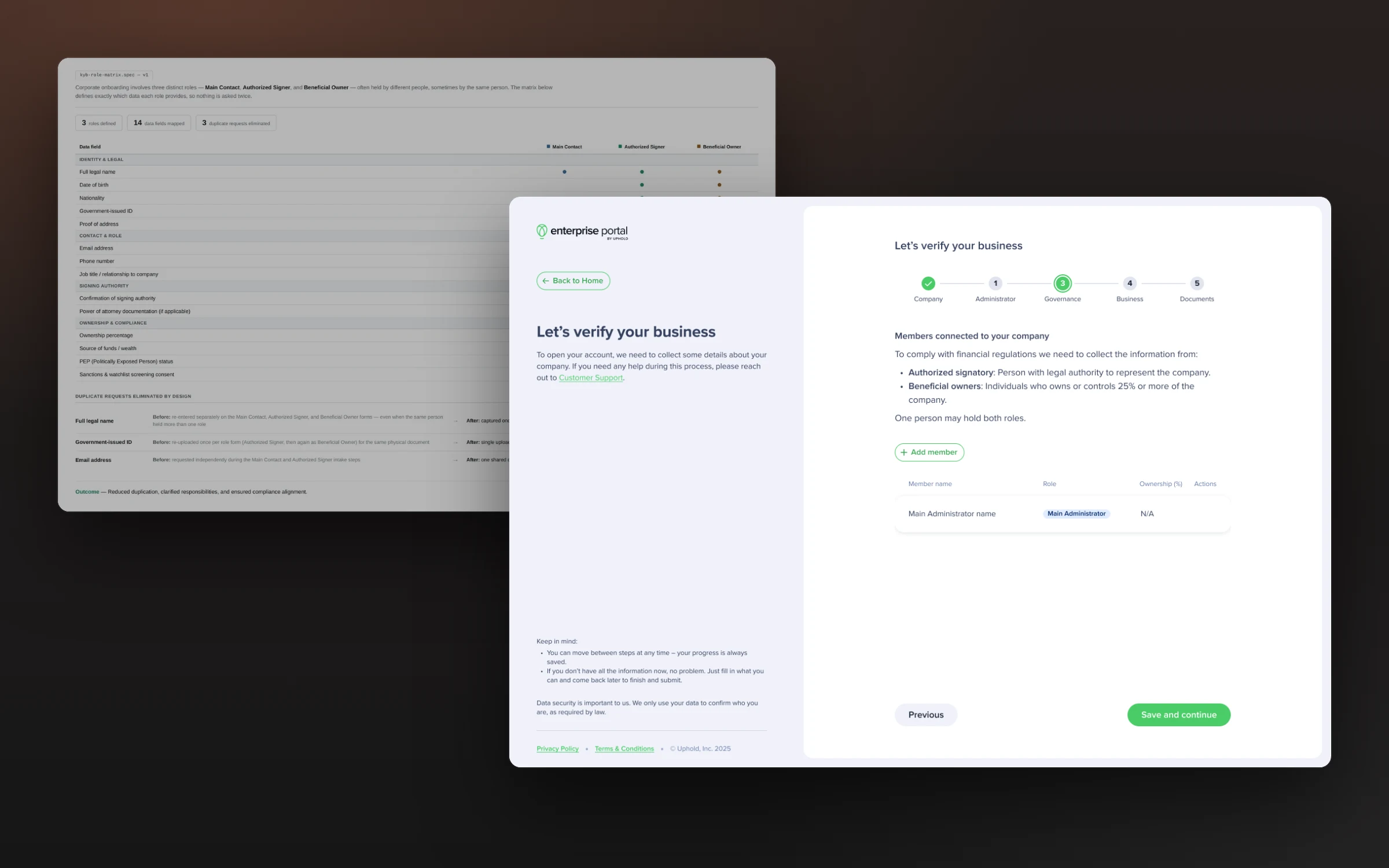
- Separated Main Contact, Authorized Signer, and Beneficial Owner
- Collected only the information each role requires
- Outcome
- Less duplication, clear responsibilities, and alignment with compliance.
05A native experience
- Rationale
- Enterprise clients need a flexible, desktop-first, consistent experience.
- Action
- Designed the flow natively in the Enterprise Portal with the internal design system
- Added progress visibility, save and resume, and editing before submission
- Outcome
- An onboarding experience that holds up across complex, multi-session enterprise use.
06Testing and iteration
- Rationale
- Validate assumptions before they reach production.
- Action
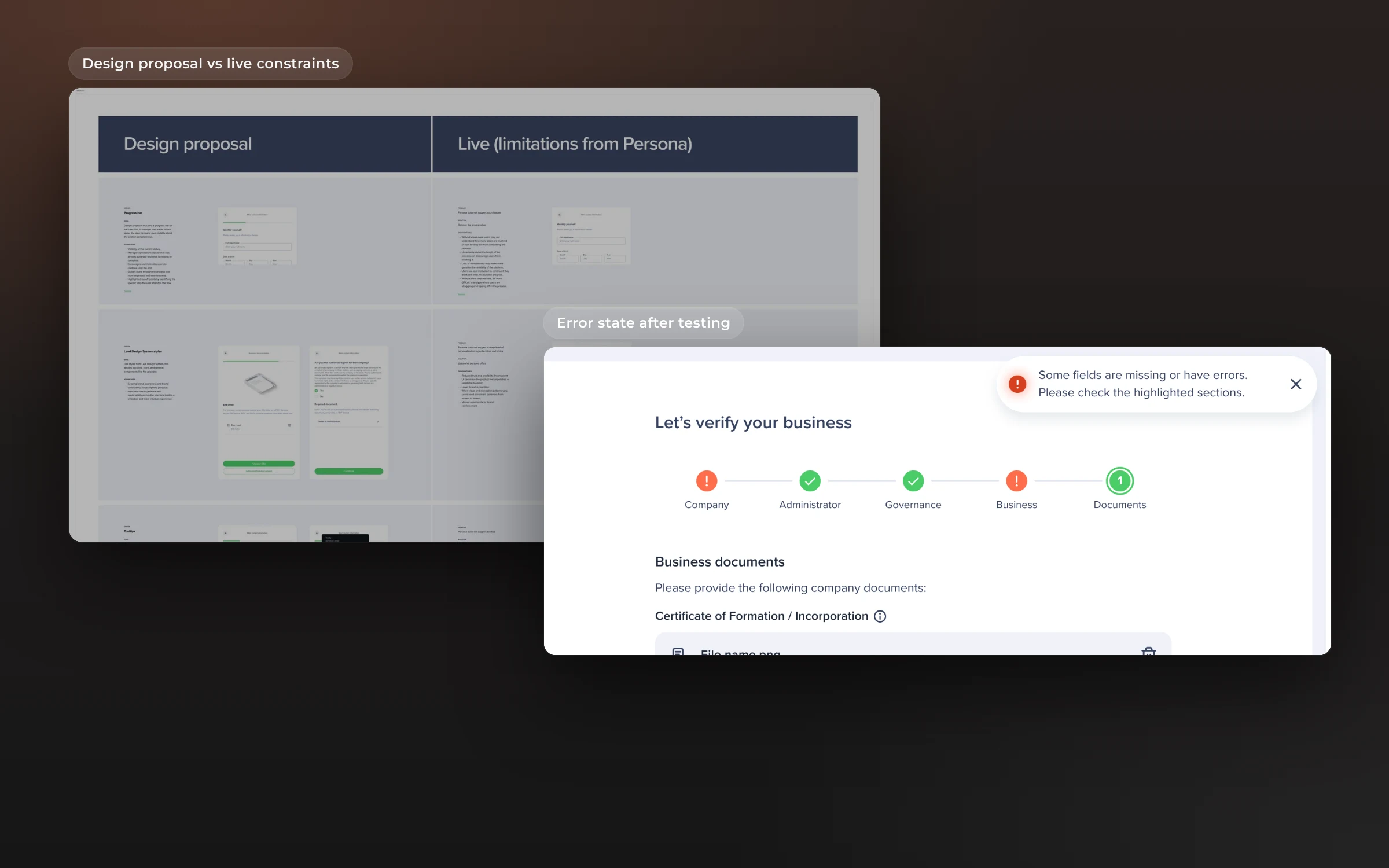
- Tested internally with real users
- Iterated on flows and layouts with feedback from Compliance and Product
- Outcome
- Confidence that the flow improves usability, reduces errors, and meets operational and regulatory requirements.
07Alignment and handoff
- Rationale
- Enterprise redesigns need buy-in across Product, Engineering, and Compliance.
- Action
- Presented findings, design rationale, and a prioritized roadmap to cross-functional teams
- Outcome
- Alignment on implementation priorities and a foundation for a scalable rollout.
Outcomes & impact
- 35% → 73%
- KYB conversion rate
- More than double the companies complete verification
- 86 → 37
- questions
- Same regulatory coverage, less than half the effort
- 30+ → 14
- days to complete KYB
- On average, from more than 30 days to 14
- −43%
- manual support
- Fewer tickets and follow-ups for the operations team
Key product decisions behind those numbers:
- Product-specific questions moved out of KYB. They were never used in compliance review, so removing them cut friction without touching regulatory requirements.
- Unrealistic document requests removed. The old flow asked for documents for every shareholder, impossible for companies with thousands of them. The redesign focuses on beneficial ownership thresholds.
- Risk questions moved earlier. High-risk country answers used to trigger automatic rejection late in the form. Surfacing them early makes the outcome transparent and avoids wasted effort.
- Built on the internal design system, so Compliance-driven changes ship faster and no longer depend on a single engineer.
Strategic UX in a regulated environment: fewer questions, clearer roles, and conversion that more than doubled.
Why this matters
What this project shows:
- Simplifying complex regulatory processes
- Restructuring information architecture for enterprise workflows
- Aligning stakeholders with conflicting priorities
- Designing scalable onboarding for regulated products
Final reflection
Compliance flows grow organically as regulations change and teams add requirements. Without deliberate product design they become harder and harder to complete.
Product thinking can simplify a regulated process without weakening it. The result is a better experience and a product foundation that is easier to scale and maintain.